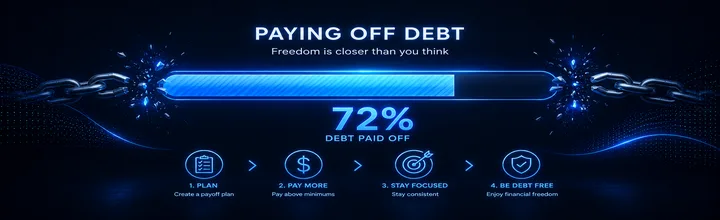
Carrying debt is expensive. Every month you carry a balance, interest compounds and the total cost grows. The faster you eliminate debt, the more of your income you free up for savings and investments that actually grow your wealth. Here are seven strategies that genuinely work.
1. The avalanche method
List all your debts from highest interest rate to lowest. Make minimum payments on everything, then throw all extra money at the highest-rate debt. Once it's gone, redirect that payment to the next highest rate.
This is mathematically optimal — it minimises the total interest you pay. If you have credit card debt at 22% and a car loan at 7%, every extra dollar goes toward the credit card first. The numbers are clear: eliminating 22% interest is a guaranteed 22% return on your money.
2. The snowball method
List debts from smallest balance to largest. Pay minimums on everything, then attack the smallest balance with all extra money. When it's cleared, roll that payment to the next smallest.
The snowball method isn't as efficient as the avalanche mathematically, but research shows it works better for many people psychologically. Clearing a debt completely — even a small one — provides a sense of progress and momentum that keeps people on track. For those who struggle with motivation, this can outweigh the mathematical disadvantage.
3. Make bi-weekly payments instead of monthly
Instead of making one monthly payment, split it in half and pay every two weeks. Because there are 52 weeks in a year, this results in 26 half-payments — the equivalent of 13 full monthly payments instead of 12. One extra payment per year sounds minor, but over a 25-year mortgage it can reduce the term by several years and save tens of thousands in interest.
4. Round up every payment
If your minimum payment is $847, pay $900. If it's $1,340, pay $1,400. Rounding up every payment to the nearest $50 or $100 costs relatively little but directs extra money straight to your principal, shortening your loan term meaningfully over time.
5. Apply windfalls directly to debt
Tax refunds, work bonuses, gifts, and any unexpected income should go straight to debt reduction before lifestyle spending can absorb them. A single $2,000 tax refund applied to high-interest debt can save far more than $2,000 in future interest charges.
💡 Before you receive a windfall, decide in advance what percentage goes to debt. The decision made in advance is far easier to stick to than one made in the moment when the money is in your account.
6. Balance transfer to a lower rate
If you have high-interest credit card debt, transferring it to a card with a 0% introductory offer or lower permanent rate can save significant money. During a 0% period, every payment goes to reducing principal rather than paying interest.
Be aware of transfer fees (typically 2–3% of the balance), the length of the 0% period, and what rate the debt reverts to afterward. Have a clear plan to pay off the balance before the promotional rate expires.
7. Increase your income temporarily
Cutting expenses has a floor — you can only reduce spending so far. Income has no ceiling. A temporary side income stream dedicated entirely to debt repayment can compress your payoff timeline dramatically. Even an extra $300–$500 per month directed at a $15,000 debt reduces the repayment period significantly.
Use our loan calculator to model exactly how much faster you'd pay off any debt by increasing your monthly payment. The amortization schedule shows you the precise impact of extra payments month by month.
Track your progress
Whatever method you use, tracking your debt balance monthly keeps you motivated and accountable. Seeing the number fall — even slowly — reinforces that your efforts are working. Many people find that visual progress trackers, even a simple chart drawn by hand, dramatically improve adherence to a debt payoff plan.
See how extra payments reduce your loan term and total interest.
Use the loan calculator →