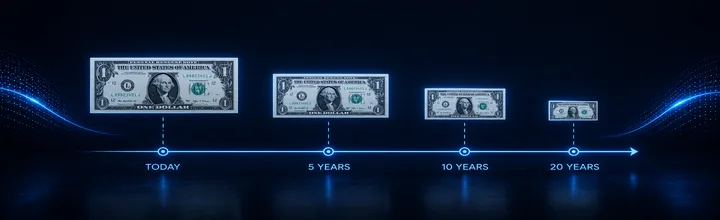
Inflation is often called the silent thief. It doesn't take money from your account — it takes purchasing power. A savings account earning 2% while inflation runs at 4% leaves you effectively poorer every year, even though your account balance is growing. Understanding how inflation works is essential for making smart savings and investment decisions.
What is inflation?
Inflation is the rate at which the general level of prices for goods and services rises over time. As prices rise, each unit of currency buys fewer goods and services. Central banks typically target a low, stable inflation rate of around 2% per year as this is associated with healthy economic growth.
When inflation is higher than this — as it was in many countries in 2022–2023 — the purchasing power of money erodes more rapidly, and the impact on savings becomes more significant.
What is the real return on savings?
The real return on your savings is the nominal (stated) interest rate minus the inflation rate. If your savings account pays 3% interest and inflation is 4%, your real return is negative 1% — you're losing purchasing power despite earning interest.
This is why simply keeping money in a low-interest savings account for decades is rarely sufficient for long-term wealth building. The money needs to grow faster than inflation to actually increase in value.
How inflation erodes savings over time
The impact of inflation compounds over time just as interest does — but in reverse. At 3% annual inflation, a sum of money loses roughly half its purchasing power every 24 years. This means $100,000 in cash today would have the purchasing power of only $50,000 in 24 years if inflation averages 3%.
This is particularly important for retirement planning. Money saved today needs to be worth enough in real terms 20, 30, or 40 years from now to support your lifestyle.
How to protect your savings from inflation
There is no single perfect inflation hedge, but several strategies help:
- Invest in equities (stocks) — historically, stock markets have returned an average of 7–10% per year over long periods, well above inflation. Companies can raise prices to keep pace with inflation, which eventually feeds through to stock values.
- Property — real estate values and rental income tend to rise with inflation over the long term, making property a reasonable inflation hedge.
- Inflation-linked bonds — government bonds specifically designed to keep pace with inflation. The principal and interest payments adjust with the inflation rate.
- High-yield savings accounts — when interest rates are high (central banks often raise rates in response to high inflation), high-yield savings accounts can offer rates that at least partially offset inflation.
- Commodities — gold and other commodities are often seen as inflation hedges, though their performance is variable.
💡 The best defence against inflation is to ensure your money is working hard enough to outpace it. Keeping large amounts in cash long-term is almost always a losing strategy in real terms.
Using compound interest to beat inflation
The most powerful tool for beating inflation is compound investment returns over long time periods. Even a modest real return of 4% above inflation doubles your purchasing power every 18 years. Starting early and staying invested consistently gives compound growth the time it needs to work effectively.
Use our compound interest calculator to model different return scenarios and see how inflation-adjusted returns affect your wealth over time.
Model different savings scenarios with our compound interest calculator.
Try the compound interest calculator →